Florida Cities Need More Revenue. Their Own Regulations May Be Standing in the Way.
Amendment 3 is forcing Florida municipalities to rethink their finances. Before cutting services or raising fees, perhaps they should examine how much economic opportunity their own regulations are preventing.
By Craig Agranoff
There’s something that has always bothered me about the way cities approach economic development.
A municipality will spend thousands of dollars trying to attract businesses, hire consultants to study redevelopment opportunities, and create elaborate plans to revitalize commercial corridors.
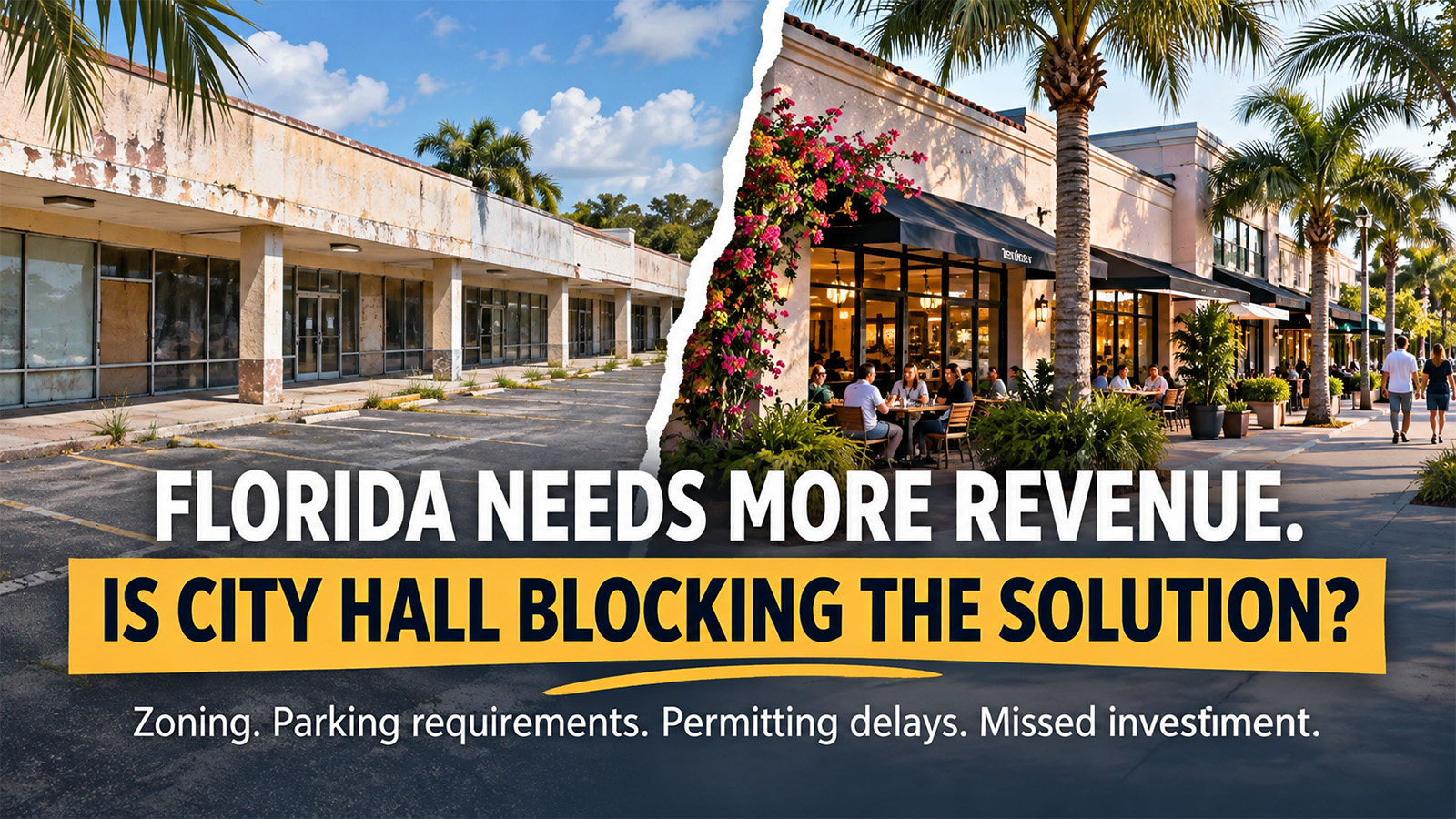
Then a property owner walks into City Hall with an actual project, and the government spends the next eighteen months explaining why it can’t be built.
Not enough parking. Wrong zoning. Setback issues. Height restrictions. Another traffic study. Another public hearing.
Eventually, the developer either changes the project until it barely resembles the original proposal or decides the investment isn’t worth the trouble.
The city moves on.
A few months later, somebody at a commission meeting complains that the city needs more economic development.
I’ve always found that contradiction remarkable.
And with Florida’s Amendment 3 now approved by voters, it’s a contradiction cities can no longer afford to ignore.
Amendment 3 Changes the Financial Conversation
On November 3, 2026, Florida voters approved Amendment 3, significantly expanding the homestead exemption for non-school property taxes.
The exemption increases to $150,000 in 2027 and $250,000 in 2028, with inflation adjustments beginning afterward. The amendment also reduces the annual assessment-growth cap for non-homestead properties from 10% to 5%.
According to Florida TaxWatch, the Legislature’s Revenue Estimating Conference projects that the changes will reduce local property tax revenue by approximately $45.8 billion over five years.
That’s a significant change in the financial environment for Florida’s counties, municipalities, and special districts.
And the effects won’t be identical everywhere.
Some cities have substantial commercial tax bases. Others rely heavily on residential property taxes. Some have diversified revenue sources, while others have limited flexibility.
But practically every city will need to take a serious look at its finances.
The immediate conversation will probably focus on spending.
Which departments can operate with less? Which contracts should be renegotiated? What services can be shared with neighboring municipalities? Which programs are essential?
Those are legitimate questions.
But there’s another side of the budget that deserves just as much attention.
How much economic activity are cities preventing through their own policies?
The Development That Never Happened
Here’s something you won’t find in a municipal budget.
The restaurant that never opened because the building didn’t have enough parking.
The property owner who wanted to convert an outdated office building into apartments but couldn’t make the zoning work.
The small developer who considered building a mixed-use project but abandoned the idea after calculating the time and expense of the approval process.
The local business that wanted to expand but discovered it would trigger requirements that made the entire project financially unrealistic.
These projects don’t show up as line items.
There’s no annual report listing the investments that were never made.
Nobody calculates the potential jobs, property improvements, or economic activity associated with every abandoned proposal.
And not every project that fails to move forward would have succeeded. Some are financially weak, poorly conceived, or genuinely incompatible with their surroundings.
But it’s difficult to evaluate a city’s economic development performance without examining the opportunities its own rules may be discouraging.
A city can proudly announce that it approved $200 million in development last year.
That’s useful information.
It tells us very little about the investment that never made it through the front door.
The Parking Space That Killed a Business
Consider a hypothetical commercial property built forty years ago.
It’s in a good location. The structure is sound. The surrounding neighborhood could support a restaurant, café, or small retail business.
An entrepreneur sees an opportunity.
The problem is parking.
The proposed use requires more parking spaces than the property can accommodate under the city’s current regulations.
The entrepreneur could seek a variance, apply for an alternative parking arrangement, or redesign the project.
Each option adds time, uncertainty, and expense.
Eventually, the entrepreneur decides to open somewhere else.
The building remains vacant.
The city hasn’t necessarily protected the neighborhood from anything. It may have prevented a viable business from occupying an existing structure.
Of course, parking requirements exist for legitimate reasons. Poorly planned projects can create congestion and spillover parking problems.
But parking demand isn’t identical for every business, neighborhood, or time of day.
A restaurant in a walkable downtown shouldn’t automatically be evaluated using the same assumptions as a restaurant along a suburban highway.
Cities need to understand the difference.
When the rules fail to recognize that difference, an empty building can remain empty because of a parking calculation rather than a lack of demand.
We Keep Trying to Revitalize Buildings Our Rules Won’t Let Anyone Reuse
Florida has no shortage of aging commercial properties.
Older shopping centers. Outdated office buildings. Former banks. Empty restaurants. Retail spaces designed for businesses that no longer exist.
Some are in excellent locations.
The problem is that the building’s original use may no longer be economically viable.
A property that once supported a bank branch might work as a restaurant, medical office, childcare facility, or another service business.
But changing the use can trigger new parking requirements, site improvements, accessibility upgrades, or other obligations.
Some requirements are essential for safety and accessibility. Others may reflect development assumptions that no longer fit the property.
The cumulative cost can make reuse difficult.
So the building stays empty.
Then the city starts discussing ways to encourage redevelopment.
There’s a certain irony in offering incentives to attract investment while maintaining regulations that make the investment unnecessarily difficult.
Before offering public money to solve a redevelopment problem, cities should determine whether their own rules are contributing to it.
Sometimes a financial incentive is necessary.
Sometimes a zoning amendment or more flexible approval process could make the difference.
Those options deserve to be examined before taxpayers are asked to subsidize a project.
Time Is a Cost, Even When Government Doesn’t Put a Price on It
I’ve noticed that government often evaluates development applications as though the applicant’s time has no financial value.
Another meeting gets scheduled.
A department requests additional information.
A review takes longer than expected.
A proposal goes back for revisions.
From the city’s perspective, these may be ordinary administrative steps.
From the investor’s perspective, money is being spent without producing income.
And uncertainty makes the financial calculation even more difficult.
Large developers may have the resources to manage prolonged approval processes.
Smaller property owners and local entrepreneurs often have much less flexibility.
That creates a problem cities should take seriously.
A process intended to ensure responsible development can unintentionally favor applicants with enough money to survive the process.
The local business owner trying to open a second location may face the same procedural requirements as a national company with a substantial development budget.
But their ability to absorb delays is very different.
If cities want more local investment, they should examine whether their approval systems are accessible to the businesses they claim to want.
A Vacant Property Is More Than a Missed Tax Opportunity
There’s another reason this matters.
A vacant commercial building doesn’t exist in isolation.
It sits next to other properties. It faces a public street. It influences how people experience the surrounding area.
A neglected storefront can make a commercial corridor feel less active.
An empty shopping center can reduce the number of reasons people visit nearby businesses.
A building that remains vacant for years may discourage additional investment, particularly if potential tenants see little evidence of improvement.
These effects aren’t automatic, and their financial impact varies by location.
But a city’s economic development strategy should consider the cumulative consequences of underused properties.
An occupied building may support employment, customers, sales, and activity that extends beyond its own property lines.
A vacant building may still generate property tax revenue, but that doesn’t capture its full potential contribution to the surrounding area.
This is where land-use policy and economic development should be working together.
If a commercial corridor is struggling, the city should examine more than its marketing strategy.
It should examine what businesses are legally permitted to operate there, what improvements are required, and how difficult it is to obtain approval.
Those decisions can influence whether investment happens at all.
Not Every Development Is Good Development
I want to be clear about something.
The solution isn’t approving every project that comes before a city commission.
Residents have legitimate concerns about traffic, flooding, infrastructure capacity, neighborhood compatibility, and the scale of development.
Florida cities have real challenges involving stormwater management, evacuation routes, aging infrastructure, and development pressure.
Those concerns deserve serious consideration.
And the financial benefits of development shouldn’t be exaggerated.
A new residential project may generate additional property tax revenue while also creating long-term expenses for roads, drainage, public safety, and other municipal services.
The fiscal outcome depends on the project and the community.
That’s why the goal should be better decision-making, not simply faster approvals.
But there’s an important distinction between regulations that address measurable public concerns and regulations that remain in place primarily because nobody has revisited them.
A parking standard adopted decades ago might deserve another look.
A zoning district that prohibits reasonable reuse of existing buildings might need updating.
An approval process requiring multiple hearings for relatively minor changes might be unnecessarily burdensome.
Cities should be willing to examine these issues with the same seriousness they apply to departmental spending.
The Opportunity Amendment 3 Creates
Florida municipalities now have a reason to examine their operating models more closely.
They’ll need to understand what services cost, which expenses are necessary, and where efficiencies might exist.
But they should also conduct an honest review of the barriers to private investment.
Start with the vacant properties.
Identify commercial buildings that have been empty for several years. Determine whether the problem is market demand, ownership, physical condition, financing, zoning, or some combination.
Then examine the projects that didn’t move forward.
How many applications were withdrawn? How long did approvals take? Which requirements repeatedly created problems? How often did businesses need variances to use existing commercial buildings?
Cities collect enormous amounts of information through their planning and permitting departments.
That information could reveal patterns worth addressing.
I’d also like to see municipalities become more transparent about development timelines.
How long does it actually take to approve a straightforward commercial renovation?
How long does a change of use require?
How much of that time is spent waiting for government review, and how much is spent waiting for the applicant to submit additional information?
Publish the numbers.
Not to embarrass employees or eliminate necessary oversight.
To understand where the process works and where it doesn’t.
The private sector routinely examines customer friction.
If customers repeatedly abandon a purchase because the process is too complicated, businesses investigate.
Government should be equally interested when investment repeatedly fails to materialize.
Economic Development Is More Than Recruiting Businesses
Cities often measure economic development through announcements.
A company relocates. A new building opens. A major employer expands. A developer breaks ground.
Those are visible accomplishments.
But economic development also involves making it easier for existing businesses to remain viable, expand, and adapt.
Sometimes the opportunity is a national company bringing hundreds of jobs.
Other times it’s a local entrepreneur taking over an empty storefront.
A property owner converting an obsolete building.
A small developer constructing a project that adds a few businesses and homes to an established neighborhood.
Those smaller investments may not generate major headlines, but collectively they contribute to the economic life of a city.
And they can be particularly important when municipalities are trying to strengthen their tax bases without taking on disproportionate infrastructure obligations.
The city doesn’t have to create every economic opportunity.
It does need to understand when its own rules are making those opportunities unnecessarily difficult.
Before Cutting Services, Look at What You’re Preventing
Amendment 3 will generate difficult financial conversations throughout Florida.
Some cities will face genuine budget constraints that cannot be solved through zoning reform or economic development alone.
New investment takes time. Property tax revenue from development isn’t immediate, and it doesn’t automatically replace the revenue lost through larger homestead exemptions.
Regulatory reform is not a substitute for responsible budgeting.
But it belongs in the conversation.
If a municipality is preparing to reduce services, increase legally permitted fees, or postpone infrastructure improvements, it should also be examining whether its development policies are unnecessarily discouraging investment.
That means asking questions that may be uncomfortable for planning departments, elected officials, developers, and residents alike.
Are our regulations accomplishing what we intended?
Are we making reasonable uses of existing buildings unnecessarily difficult?
Have we created approval processes that favor large developers over smaller local investors?
Are we protecting neighborhoods from genuine problems, or simply preserving rules that nobody has questioned in decades?
And perhaps most importantly, how many opportunities have we lost without ever realizing they existed?
Florida cities are entering a period when every dollar will receive more scrutiny.
It’s reasonable to expect government to spend money carefully.
It’s just as reasonable to expect government to examine the economic opportunities its own decisions may be preventing.
Before telling residents what their city can no longer afford to provide, City Hall should understand what it may have made unnecessarily difficult to build.
Craig Agranoff is a South Florida marketing executive, economic growth thought leader, and professor at Florida Atlantic University. He writes about the intersection of local government, economic development, real estate, marketing, and the decisions that shape our communities.