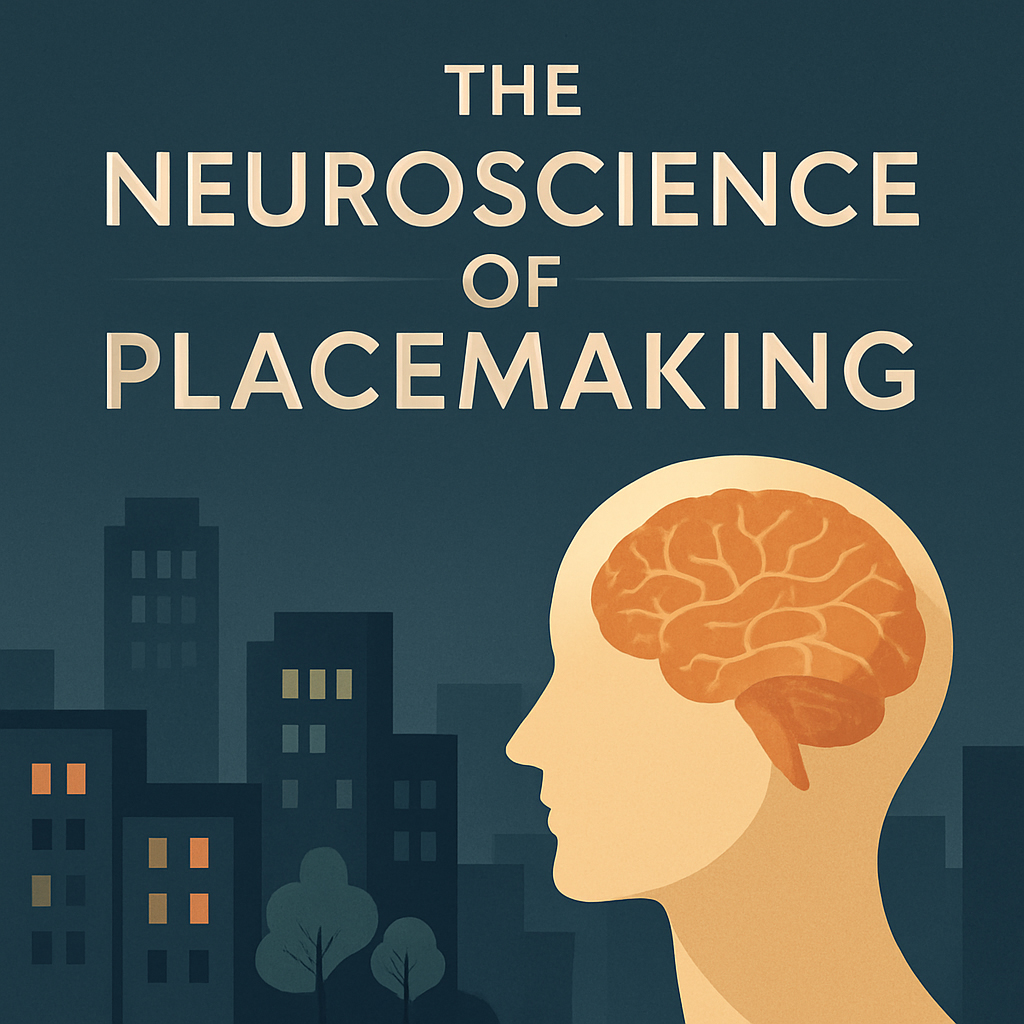
Your Brain Knows Where You Want to Live Before You Do
How Neuroscience Is Quietly Rewriting Urban Planning and Place Branding
Most people believe they choose a city or neighborhood based on rational factors. Jobs. Schools. Taxes. Commute times. We repeat these explanations because they sound responsible. They present us as measured decision makers. But neuroscience tells a different story.
Your brain decides whether a place feels right long before you start listing pros and cons. The rational story comes later. What looks like a “choice” is usually a justification for an emotional response that happened in a few hundred milliseconds.
This is not an insult. It is biology. And it explains why so many cities struggle with growth, pride, and attachment while doing everything “by the book.” They are marketing to the conscious mind when the subconscious is the one making the call.
If we want cities that attract people, retain talent, and spark pride, we need to design and brand them with the brain in mind. Because the truth is simple. People do not fall in love with spreadsheets. They fall in love with places that make them feel something.
The Brain Makes Place Decisions Before We Can Explain Them
When you walk through a neighborhood for the first time, your brain launches an instant evaluation. Vision, sound, spatial geometry, greenery, and social cues are processed at speeds your conscious mind cannot keep up with.
Urban design is not only functional. It is neurological.
Studies from Oxford, MIT, and the University of Waterloo show that the brain forms judgments about safety, comfort, and desirability in milliseconds. A cracked sidewalk changes your heart rate. A tree canopy lowers cortisol. A narrow street releases reward chemicals because it feels coherent and human scaled.
The built environment writes directly into the nervous system.
This is why people say things like, “This area just feels good,” or, “I don’t know why, but I don’t like it here.” They are not being vague. They are translating neurological signals into language.
Urban planners who ignore this are designing through a keyhole.
Neuromarketing Shows Why Some Places Win and Others Wither
Neuromarketing is built on one principle. People think they think, but mostly they feel. And the subconscious drives most behavior.
When companies design storefronts, packaging, or digital experiences, they test emotional responses first because emotion predicts action. Urban planning has almost never done this. The result is predictable. Cities built for cars instead of people. Districts that look efficient but feel empty. Streets that function on paper but fail on the ground.
If neuromarketing can persuade someone to buy shampoo, imagine what it can do when applied to the emotional weight of choosing a home.
Place branding is not about logos or slogans. It is about designing an environment that creates the emotional rewards the brain seeks.
The subconscious wants simple things.
Coherence.
Beauty.
Greenery.
Safety cues.
Social energy.
Spatial clarity.
Visual rhythm.
The more a place aligns with these neurological rewards, the easier it is for people to imagine themselves living there.
Cities that ignore this lose talent not because of taxes, but because they feel stressful.
Why People Flock to Some Cities Even When They Cost More
Traditional economic development theory cannot explain why people pay a premium to live in walkable, beautiful urban neighborhoods. Neuroscience can.
A place that triggers positive emotional signals becomes more valuable, not because of its square footage, but because of how the brain experiences life there. Meaning is not created by zoning maps or pro formas. It is created by sensory and emotional cues that deepen daily living.
People pay for:
The mood boost from a leafy street
The comfort of human scaled design
The calm of reduced noise
The social safety provided by foot traffic
The identity tied to a place with beauty and culture
These are not luxuries. They are biological drivers.
Which is why trying to compete with cheaper sprawl is pointless. Sprawl suppresses the very neurological triggers that build attachment.
The Subconscious Writes the Story of a City Long Before the City Does
A resident’s emotional relationship with their city is based on small, repeated cues. A streetlight that works. A building maintained. A storefront alive. A crosswalk painted. A tree canopy casting shade. These signals tell the brain, “Someone cares about this place.”
Neglect sends the opposite message.
People detach from cities the same way they detach from relationships. Slowly, through accumulated disappointments. Once pride erodes, no amount of branding can compensate.
Place branding is not a communications exercise. It is an environmental psychology exercise.
The most powerful city marketing campaign is a block that looks cared for.
The New Frontier: Designing Cities With the Brain as the Client
If we align neuroscience with planning and branding, we get a new model for development. One where cities stop guessing what people want and start responding to how human beings actually function.
Attachment first. Pride later. Investment follows.
Old Place Branding:
Slogans, websites, logos.
Neurological Place Branding:
Environment, identity, beauty.
Places that imprint on the brain before the brochure arrives.
Why This Matters Now More Than Ever
The competition for residents is no longer a competition for jobs. It is a competition for emotion. If a place feels good, it wins. If a place feels stressful, no incentive package can save it.
This is why cities with walkable neighborhoods, street trees, mixed use, and strong aesthetics outperform cities twice their size. They align with the biology of human happiness and the psychology of choice.
A city is not chosen because it is efficient. It is chosen because it resonates.
When planners, mayors, and economic developers understand the human brain, everything changes. The goal stops being to move cars and starts being to move people emotionally.
Because people do not relocate for features. They relocate for feelings.
The Brain Is the Real Urban Planner
If cities want to attract residents, retain talent, and spark pride, they must recognize a simple truth.
The human brain is the real end user.
It responds to beauty before policy.
It responds to coherence before complexity.
It responds to safety before strategy.
It responds to emotion before logic.
Cities that embrace this will rise.
Cities that ignore it will keep wondering why no one shows up.
The next great chapter of urban planning will not be written by traffic engineers. It will be written by neuroscientists, designers, and place strategists who understand that the most powerful force in city building is not the budget.